




 This copper sulfate has got to be my favorite. The blue color is just mesmerizing!




 This copper sulfate has got to be my favorite. The blue color is just mesmerizing!
 This is the drawing tree for the Sonex Aircraft. Your start at a branch on the bottom and work your way up. When all the branches of the drawing tree are complete, your airplane is also complete.
 These are the wing skins and as you can see, they are pre-drilled for assembly with the ribs and spars. The holes are actually undersized, so Clecos can be used for temporary assembly, then the holes are drilled to the right size and blind rivets are installed. The pre-drilling for the rigging is a incredible time saver.
 Rudder hinge detail


 The gear legs are titanium. Phil said they were a bit tricky to drill to install the retaining bolts.
 This is the one piece, roto-molded fuel tank.
 Engine cowling halves

 The cylindrical copper colored devices are Clecos - basically a temporary clamp that holds multiple pieces of sheet aluminum in place via the rivet holes. These align the parts while the holes are being drilled to the correct size and rivets are being set (installed).
 The tailwheel is basically a grocery cart wheel - functional, light and cheap.


 This rectangular cutout is where the wing spar passes through the fuselage.
 The rudder pedals ride on a phenolic bearing block for low friction and long life.
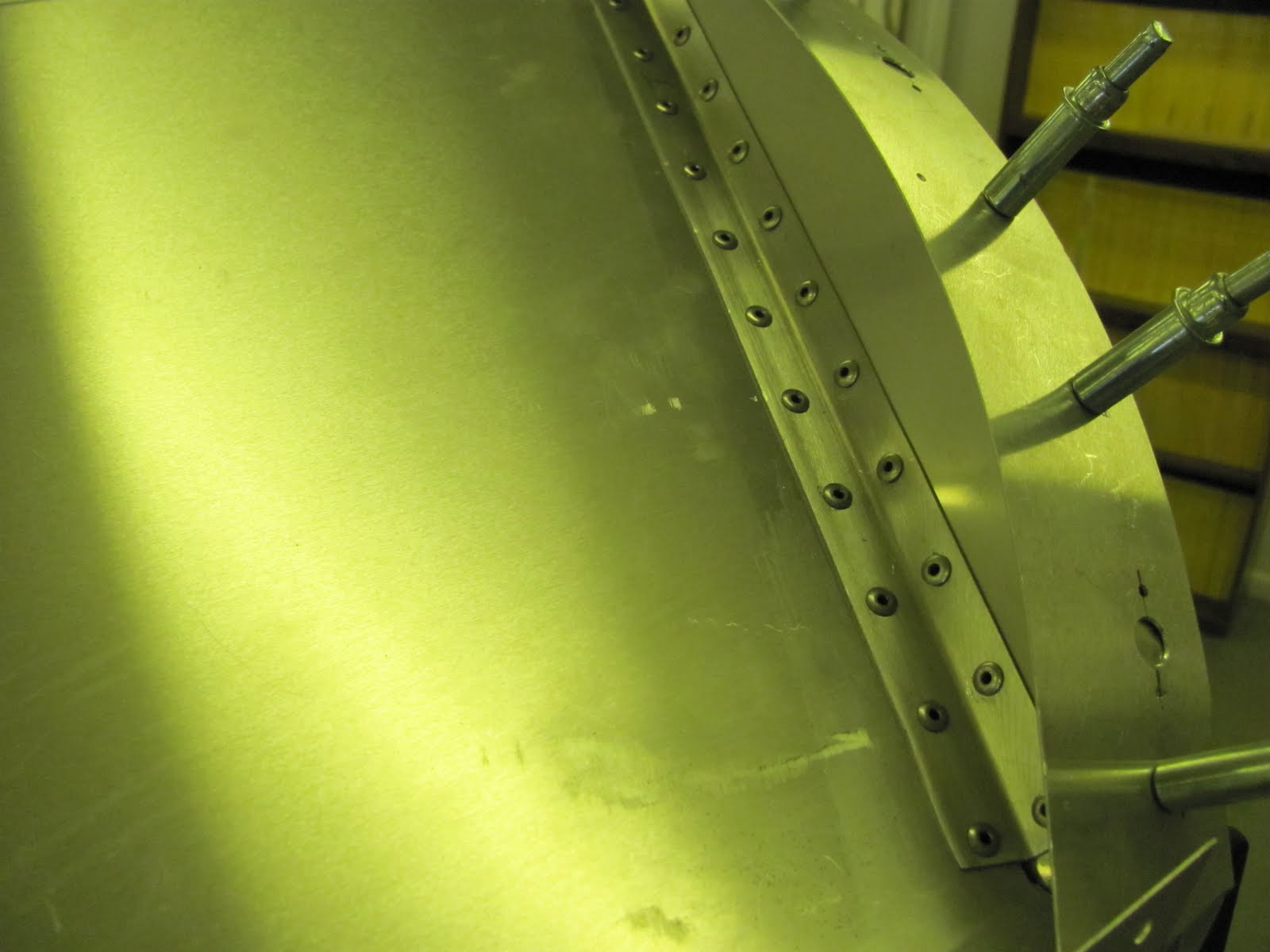

 Wheel pants

 The tail gear rod is also titanium.
 Elevator trim tab
 Phil, a builder in Logan showed me his Sonex project this weekend. He has completed most of the fuselage and tail and now is going to start on the wings.
 Radiation Hormesis is a wonderful book that has profound implications regarding the linear, no-threshold hypothesis of safe levels of radiation. In short, chronic exposure to radiation is not the same as acute exposure to radiation. Paracelsus said it this way, "The dose makes the poison." Consider vitamin C, not enough causes scurvy, but too much can be toxic. This book is filled with technical studies that show that Paracelsus' dictum applies to ionizing radiation; the dose is what counts! This book dispels the irrational fear and hysteria of radiation. That's why I like it!
This particular blog has been a long time coming. I can’t remember how I first starting thinking along these lines, but I have been writing this blog in my head for months.
Ludwig Von Mises wrote a great work about economics and human behavior called Human Action. When we humans act and interact, we are lucky to have language, which allows us to collaborate and cooperate, and which is truly divine.
(Aside – I heap scorn on those who intentionally debase language, and I’m not talking the obscene. I am talking about words like “quantitative easing” recently spun from the bowels of the FED to describe creating $600 billion and injecting it into the money supply. Or, “enhanced pat-down” to describe the groping air travelers get at the hands of the TSA. – End Aside)
When humans start acting, they soon desire to interact with others and to do so requires that one identify and use nomenclature – words. The more esoteric the field of action, the more careful one has to be with the words that are used. Aviation, for example, has words like fuselage, aileron, rib, wing, spar, cowling, nacelle, tubing, weld, strut, pitot tube, cable, bell crank, vacuum pump, magneto, etc. You cannot interact meaningfully with others unless you both agree on what these words mean.
The word I would like to discuss in this blog is “time”.
We all know time by common experience, yet a rigorous scientific definition alludes us. For example, under the International System of Units, a second is defined as “the duration of 9,192,631,770 periods of the radiation corresponding to the transition between the two hyperfine levels of the ground state of the cesium 133 atom”. This is the basis of an atomic clock and tells us what an internationally agreed-to definition of a second is, but not what time is.
I believe that all watches and clocks, including atomic clocks, should be called counters, for that is what they do. They count periods, transitions, revolutions, vibrations, oscillations, grains of sand, drops of water, orbits, and other proxies for time, but they do not measure time. Clocks allow us to make comparisons of velocity and simultaneity, but they don’t tell us what time is.
My birth cohort can expect to live about 82 years (male) or 84 years (female). We understand what that is in very earthly ways. Eighty two summers, eighty two winters, then it’s on to our Maker. Again, we are talking revolutions of the earth around the sun. If we are lucky and our lives are not cut short by accident or disease, that is what we will experience.
Yet, what is time? Is it some quantity that we can hold on to, like a quart of oil, a liter of Coke, a pound of sand, 9 volts, a gigabyte, or a mole of some substance?
(Aside - The best way to quickly test a 9 volt battery is to briefly touch it to your tongue, You can judge the battery condition by the buzz. Strong buzz - new battery, weak buzz - weak battery. Of course, don’t try this with anything bigger than a 9 volt battery. - End Aside)
How could Einstein possibly have been right about relativity if he couldn’t even define what time is?
(Last Aside, I promise. Einstein was not the originator of the idea of mass and energy equivalence. In 1717, Isaac Newton speculated that light particles and matter particles were inter-convertible. Also, I obviously believe in fission and fusion, since that is one of the topics of this blog. – End Aside)
This, I contend, is where Einstein went wrong from the beginning. He forgot to define his terms before he proceeded to elaborate on time dilation and other topics. Of course, two clocks count oscillations differently when then are traveling at immense speeds, but they are not measuring time, only some proxy of unknown reliability for time!
I do believe anyone who wishes to defend Einstein needs to define their terms before putting on their Star Trek costumes and launching into paroxysms of fantasy about wormholes and time travel. These, of course, make good entertainment, but have they led to advances in human action?


